Datasets and the atlas: browse, load, fetch
U-Chrom’s datasets come from three places: the atlas (public stores that open over HTTP), datasets with a
loader (built once from their original files) and the original files themselves. This tutorial goes
through all three with uchrom.datasets:
browse the atlas — what is there, for which organism, with which modalities;
load a store over HTTP and read one cell of it: its 3-D structure and its contact map;
fetch the store as one file for offline work, and load the local copy;
datasets with a loader, and original files.
Data: the atlas store
stevens2017_mesc(Stevens et al. 2017, Nature 544:59: 8 haploid mESCs, 100 kb structures, 26 MB), the loader datasettakei2021_mescand the Takei 2021 cell table (4DN).Runtime: about a minute on a laptop (a 26 MB download).
import time
from pathlib import Path

import matplotlib.pyplot as plt
import numpy as np
import pandas as pd

import uchrom.datasets as ds
from chromdata import catalog
from uchrom.fea import contact_matrix

plt.rcParams["figure.dpi"] = 90
T0 = time.time()
DATA = ds.data_dir()
print("data directory:", str(DATA).replace(str(Path.home()), "~"))     # $UCHROM_DATA, else ~/.cache/uchrom
data directory: ~/.cache/uchrom
1. Browse the atlas
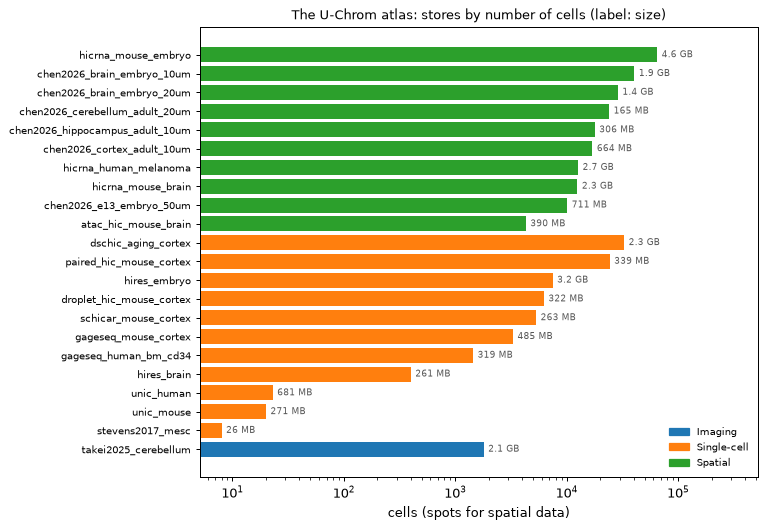
ds.list_atlas() reads the atlas catalog: one row per store, with what it is, how many cells (spots, for
spatial data) it holds, its modalities, its size and its one-file download. The same datasets are on the
atlas page, uchrom-atlas.u-science.org, and open in the hosted web
browser, uchrom-browser.u-science.org.
atlas = ds.list_atlas()
print(f"{len(atlas)} stores, {atlas['n_cells'].sum():,} cells / spots, {atlas['size_mb'].sum() / 1e3:.1f} GB")
atlas[["title", "organism", "assembly", "n_cells", "size_mb", "downloaded"]].sort_values("n_cells")
22 stores, 315,516 cells / spots, 25.6 GB
| title | organism | assembly | n_cells | size_mb | downloaded | |
|---|---|---|---|---|---|---|
| id | ||||||
| stevens2017_mesc | Single-cell Hi-C and 3-D structures: haploid m... | Mus musculus | mm10 | 8 | 25.8 | False |
| unic_mouse | Uni-C: mouse circulating tumour cells and MC38 | Mus musculus | mm10 | 20 | 270.9 | False |
| unic_human | Uni-C: human cell lines and circulating tumour... | Homo sapiens | hg19 | 23 | 681.2 | False |
| hires_brain | HiRES: adult mouse brain | Mus musculus | mm10 | 399 | 260.9 | False |
| gageseq_human_bm_cd34 | GAGE-seq: human bone marrow CD34+ | Homo sapiens | hg38 | 1445 | 319.0 | False |
| takei2025_cerebellum | DNA seqFISH+: adult mouse cerebellum | Mus musculus | mm10 | 1799 | 2050.7 | False |
| gageseq_mouse_cortex | GAGE-seq: mouse cortex | Mus musculus | mm10 | 3296 | 484.9 | False |
| atac_hic_mouse_brain | Spatial ATAC-Hi-C: mouse brain | Mus musculus | mm10 | 4290 | 389.7 | False |
| schicar_mouse_cortex | scHiCAR: mouse frontal cortex, contacts, acces... | Mus musculus | mm10 | 5313 | 262.8 | False |
| droplet_hic_mouse_cortex | Droplet Hi-C: mouse cortex | Mus musculus | mm10 | 6235 | 321.5 | False |
| hires_embryo | HiRES: mouse embryo, E7.0 to E9.5 | Mus musculus | mm10 | 7469 | 3174.2 | False |
| chen2026_e13_embryo_50um | Spatial Hi-C: E13 embryo (50 µm) | Mus musculus | mm10 | 10112 | 711.4 | False |
| hicrna_mouse_brain | Spatial Hi-C-RNA: mouse brain | Mus musculus | mm10 | 12474 | 2254.0 | False |
| hicrna_human_melanoma | Spatial Hi-C-RNA: human melanoma | Homo sapiens | hg38 | 12649 | 2727.7 | False |
| chen2026_cortex_adult_10um | Spatial Hi-C: adult cortex (10 µm) | Mus musculus | mm10 | 16986 | 664.1 | False |
| chen2026_hippocampus_adult_10um | Spatial Hi-C: adult hippocampus (10 µm) | Mus musculus | mm10 | 17817 | 305.9 | False |
| chen2026_cerebellum_adult_20um | Spatial Hi-C: adult cerebellum (20 µm), withou... | Mus musculus | mm10 | 24022 | 164.8 | False |
| paired_hic_mouse_cortex | Paired Hi-C: mouse cortex, contacts and RNA | Mus musculus | mm10 | 24284 | 339.3 | False |
| chen2026_brain_embryo_20um | Spatial Hi-C: embryonic brain E14.5 to E18.5 (... | Mus musculus | mm10 | 28769 | 1446.1 | False |
| dschic_aging_cortex | dscHi-C: aging mouse cortex | Mus musculus | mm10 | 32777 | 2277.9 | False |
| chen2026_brain_embryo_10um | Spatial Hi-C: embryonic brain E14.5 to E18.5 (... | Mus musculus | mm10 | 40468 | 1887.2 | False |
| hicrna_mouse_embryo | Spatial Hi-C-RNA: mouse embryo (E11.5, E13.5) | Mus musculus | mm10 | 64861 | 4577.6 | False |
# what kind of data each store holds: the catalog's studies say it (spatial, single-cell, imaging)
cat = catalog.fetch_catalog(catalog.DEFAULT_ATLAS)
kind = {s["id"]: s.get("category", "") for s in cat["studies"]}
atlas["kind"] = atlas["study"].map(kind)
order = atlas.sort_values(["kind", "n_cells"])
colors = {k: f"C{i}" for i, k in enumerate(sorted(order["kind"].unique()))}

fig, ax = plt.subplots(figsize=(8, 6.5))
ax.barh(range(len(order)), order["n_cells"], color=[colors[k] for k in order["kind"]])
ax.set_yticks(range(len(order)), order.index, fontsize=8)
ax.set_xscale("log"); ax.set_xlabel("cells (spots for spatial data)")
for i, (n, mb) in enumerate(zip(order["n_cells"], order["size_mb"])):
    ax.text(n * 1.1, i, f"{mb / 1e3:.1f} GB" if mb >= 1000 else f"{mb:.0f} MB", va="center", fontsize=7, color="0.35")
ax.legend(handles=[plt.Rectangle((0, 0), 1, 1, color=c) for c in colors.values()], labels=list(colors),
          loc="lower right", fontsize=8, frameon=False)
ax.set_title("The U-Chrom atlas: stores by number of cells (label: size)", fontsize=10)
ax.set_xlim(right=order["n_cells"].max() * 8)
plt.show()
Selecting by modality: e.g. the stores with 3-D structures (imaging, or structures reconstructed from single-cell Hi-C).
atlas[atlas["modalities"].map(lambda m: "3-D coordinates" in m)][["title", "n_cells", "modalities"]]
| title | n_cells | modalities | |
|---|---|---|---|
| id | |||
| stevens2017_mesc | Single-cell Hi-C and 3-D structures: haploid m... | 8 | [Hi-C per cell, Hi-C bulk, 3-D coordinates] |
| hires_brain | HiRES: adult mouse brain | 399 | [Hi-C per cell, Hi-C bulk, RNA, 3-D coordinate... |
| hires_embryo | HiRES: mouse embryo, E7.0 to E9.5 | 7469 | [Hi-C per cell, Hi-C bulk, RNA, 3-D coordinate... |
| takei2025_cerebellum | DNA seqFISH+: adult mouse cerebellum | 1799 | [signals per spot, 3-D coordinates, embeddings] |
2. Load a store over HTTP
ds.load(id) opens an atlas store backed: the small tables are read at once, everything else when it is
asked for — one cell, one chromosome, one level of a contact map — with HTTP range requests. Nothing is
downloaded up front.
t = time.time()
cd = ds.load("stevens2017_mesc")
print(f"opened in {time.time() - t:.1f} s\n")
print(cd)
print("\n", cd.uns["coordinate_status"])
cd.cells
opened in 2.1 s

ChromData (backed: stevens2017_mesc.chromdata.zarr): n_spots=205706, n_traces=160, n_cells=8, n_bins=25734
  spots:   ['chrom', 'start', 'end', 'trace_id', 'cell_id', 'bin_id']
  cells:   ['gsm', 'n_contacts', 'cell_type'] (8 cells)
  layers:  ['model_2', 'model_3', 'model_4', 'model_5', 'model_6', 'model_7', 'model_8', 'model_9', 'model_10']
  uns:     ['genome_assembly', 'xyz_unit', 'source', 'coordinate_status', 'linked_cool', 'linked_scool']

 the authors' NucDynamics structures, 100 kb particles: model 1 in coords, models 2-10 in layers
| gsm | n_contacts | cell_type | |
|---|---|---|---|
| cell_id | |||
| Cell_1 | GSM2219497 | 111838 | haploid mESC (G1) |
| Cell_2 | GSM2219498 | 79569 | haploid mESC (G1) |
| Cell_3 | GSM2219499 | 31507 | haploid mESC (G1) |
| Cell_4 | GSM2219500 | 88866 | haploid mESC (G1) |
| Cell_5 | GSM2219501 | 69273 | haploid mESC (G1) |
| Cell_6 | GSM2219502 | 72323 | haploid mESC (G1) |
| Cell_7 | GSM2219503 | 53119 | haploid mESC (G1) |
| Cell_8 | GSM2219504 | 40217 | haploid mESC (G1) |
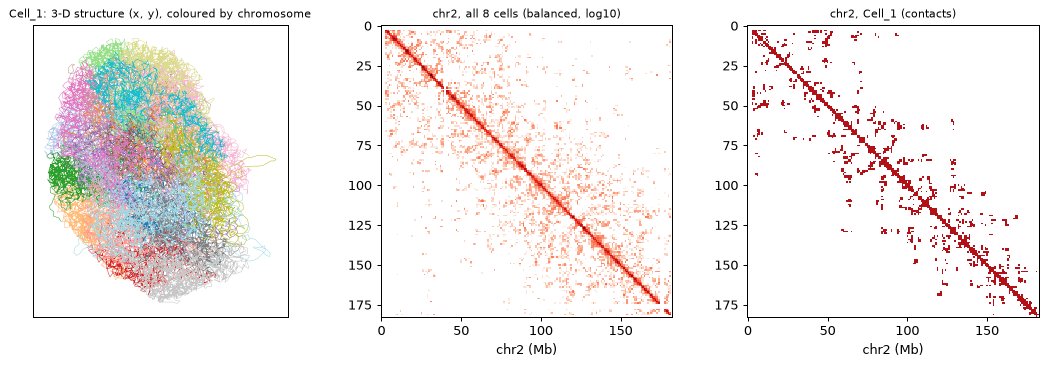
The store also holds contact maps, embedded: the merged map of all cells (bulk: 100 kb, 500 kb, 1 Mb)
and one map per cell (per_cell, 1 Mb). Reading one cell gives an in-memory ChromData of that cell’s
structure; the maps are read the same way, one level or one cell at a time.
t = time.time()
cell = cd.get_cell("Cell_1")                                       # 8 cells x 20 chromosomes x 100 kb particles
print(f"Cell_1: {cell.n_spots:,} particles, {cell.n_traces} chromosomes, read in {time.time() - t:.1f} s")

t = time.time()
bins, bulk = contact_matrix(cd, "bulk", chrom="chr2", resolution=1_000_000)   # merged map, one level exported
one = cd.load_linked_scool(key="per_cell", cell="Cell_1")                    # one cell's map (a cooler)
single = one.matrix(balance=False).fetch("chr2")
print(f"chr2 at 1 Mb: merged map {bulk.shape}, Cell_1 {int(np.nansum(np.triu(single)))} contacts, "
      f"read in {time.time() - t:.1f} s")
Cell_1: 25,724 particles, 20 chromosomes, read in 6.2 s
chr2 at 1 Mb: merged map (183, 183), Cell_1 7676 contacts, read in 8.4 s
spots = cell.spots_with_loci()
xyz = cell.coords
chroms = spots["chrom"].astype(str).to_numpy()
fig = plt.figure(figsize=(12, 4))
ax = fig.add_subplot(1, 3, 1)
for k, c in enumerate(pd.unique(chroms)):
    s = chroms == c
    ax.plot(xyz[s, 0], xyz[s, 1], lw=0.4, color=plt.cm.tab20(k % 20))
ax.set_aspect("equal"); ax.set_xticks([]); ax.set_yticks([])
ax.set_title("Cell_1: 3-D structure (x, y), coloured by chromosome", fontsize=9)
for j, (m, title) in enumerate(((bulk, "chr2, all 8 cells (balanced, log10)"), (single, "chr2, Cell_1 (contacts)")), 2):
    ax = fig.add_subplot(1, 3, j)
    img = np.log10(np.where(m > 0, m, np.nan)) if j == 2 else np.where(single > 0, 1.0, np.nan)
    ax.imshow(img, cmap="Reds", interpolation="none", **({} if j == 2 else {"vmin": 0, "vmax": 1.2}))
    ax.set_title(title, fontsize=9); ax.set_xlabel("chr2 (Mb)")
plt.tight_layout(); plt.show()
3. Fetch a local copy for offline work
ds.fetch(id) downloads the store’s one-file copy (.cdz: the same files, in one uncompressed zip) into the
data directory, once. From then on ds.load(id) opens the local copy — the same ChromData, read from
disk. ds.atlas(id, local=False) still reads the remote store.
t = time.time()
path = ds.fetch("stevens2017_mesc", verbose=False)
print(f"<data directory>/{path.relative_to(DATA)} ({path.stat().st_size / 1e6:.1f} MB) in {time.time() - t:.1f} s")
print("downloaded:", ds.list_atlas().loc["stevens2017_mesc", "downloaded"])

local = ds.load("stevens2017_mesc")
remote = ds.atlas("stevens2017_mesc", local=False)
for name, obj in (("local copy", local), ("over HTTP", remote)):
    t = time.time()
    c = obj.get_cell("Cell_2")
    print(f"{name:10s}: Cell_2 with {c.n_spots:,} particles in {time.time() - t:.2f} s")
assert np.allclose(local.get_cell("Cell_2").coords, remote.get_cell("Cell_2").coords)
<data directory>/atlas/stevens2017_mesc.cdz (25.6 MB) in 1.9 s
downloaded: True
local copy: Cell_2 with 25,719 particles in 0.02 s
over HTTP : Cell_2 with 25,719 particles in 5.77 s
4. Datasets with a loader, and original files
ds.list_datasets() is the registry of everything U-Chrom knows how to get: the column load marks the
datasets that come as a ChromData (built once from the original files by a loader, then read from the data
directory), the others are files — raw formats, reference genomes, annotations, published calls.
reg = ds.list_datasets()
print(f"{len(reg)} entries, {int(reg['load'].sum())} with a loader")
reg[reg["load"]][["size_mb", "description"]]
52 entries, 10 with a loader
| size_mb | description | |
|---|---|---|
| name | ||
| bintu_imr90 | 2.0 | Bintu 2018 IMR90 chr21 chromatin tracing |
| su2020_chr21 | 262.0 | Su 2020 IMR90 chr21 chromatin tracing + binned... |
| tan2018_gm12878 | 700.0 | Tan 2018 Dip-C GM12878, 17 cells: hickit imput... |
| wu2025_scmicroc | 3100.0 | Wu 2025 scMicro-C GM12878, 12 deepest cells: h... |
| kim2020_scihic | 128.0 | Kim 2020 sci-Hi-C, H1 ES + HFF (Noble lab) |
| huang2021_sox2 | 7.0 | Huang 2021 mESC Sox2 tracing with missing loci... |
| rao2014_imr90_chr21 | 4.0 | Rao 2014 IMR90 Hi-C chr21 at 5 kb, sliced over... |
| takei2021_mesc | NaN | Takei 2021 mESC DNA seqFISH+ (4DN FOF-CT): 201... |
| bintu_imr90_hg19 | NaN | Bintu 2018 IMR90 chr21 tracing on hg19 (20.0-2... |
| takei2021_mesc_detections | NaN | Takei 2021 mESC raw DNA seqFISH+ detections (Z... |
t = time.time()
tracing = ds.load("takei2021_mesc")                 # built on first use, read from the data directory afterwards
print(f"takei2021_mesc in {time.time() - t:.1f} s: {tracing.n_cells} cells, {tracing.n_traces:,} traces, "
      f"{tracing.n_spots:,} spots")

ds.fetch("takei_tables", verbose=False)             # original files: the 4DN cell and RNA tables (md5-checked)
for f in ds.files("takei_tables"):
    print(f"<data directory>/{f.relative_to(DATA)}: {f.stat().st_size / 1e3:.0f} KB")
print("read by: ChromData.from_fofct(core, cell_table=..., rna_table=...) — the FOF-CT import tutorial")
takei2021_mesc in 0.0 s: 201 cells, 8,285 traces, 316,995 spots
<data directory>/4DNFIFINA2U9.csv: 58 KB
<data directory>/4DNFIJ52NVDV.csv: 219 KB
read by: ChromData.from_fofct(core, cell_table=..., rna_table=...) — the FOF-CT import tutorial
Where it all goes
Downloads and built datasets live in the data directory, $UCHROM_DATA (else ~/.cache/uchrom); set it to put
large data elsewhere (a cluster’s scratch space). The same operations from a shell:
python -m uchrom.datasets atlas                       # the atlas, with what is downloaded
python -m uchrom.datasets fetch stevens2017_mesc      # an atlas store (.cdz)
python -m uchrom.datasets list                        # the registry
python -m uchrom.datasets load takei2021_mesc         # build a loader dataset ahead
python -m uchrom.datasets fetch takei hg19_chr21      # original files
Where every dataset comes from — study, accession, licence, size — is in the data sources.
print(f"total run time {time.time() - T0:.0f} s")
total run time 27 s